AI & Data
MLOps sized to the models you actually run
One model retrained twice a year needs a scheduled job and a checklist. Dozens of models in production need pipelines, a registry, drift monitoring and promotion gates. We build the version that fits, on the platform you already pay for.
Our Services
MLOps services, from assessment to operations
Strategy, platform, pipelines, monitoring, governance and managed operations. Most teams need two or three, chosen after the maturity assessment.
MLOps Consulting & Strategy
A review of your pipelines, model lifecycle, deployment and governance, ending in a ranked roadmap sized to your team, your budget and the number of models you run.
MLOps Platform Development
Feature store, model registry, training orchestration and serving, built on your cloud or your own GPU clusters and defined entirely as code.
ML Pipeline Implementation
Notebook models turned into versioned, repeatable pipelines: data checks, features, tuning, evaluation and promotion, all wired into CI/CD.
Model Monitoring & Observability
Green infrastructure dashboards say nothing about prediction quality. Drift, prediction quality, data distributions and bias are tracked, with alerts routed to people who can act - even when labels arrive weeks late.
ML Governance & Compliance
Model cards, lineage, audit trails and reproducible predictions: the evidence a model-risk or regulatory review asks for, produced by the pipeline instead of assembled by hand.
Managed MLOps Services
We can run the stack while your team builds models: upgrades, incident response and on-call, with a defined route to hand it back when you want to operate it yourselves.
OUR PROCESS
From maturity assessment to production MLOps
Six phases, each with a defined artefact and entry criteria for the next. The assessment decides how far the rest should go.
Maturity Assessment
Interviews with data scientists, engineers and compliance staff, plus a look at the systems themselves, rate each of the five areas.
You get a scored benchmark, a ranked list of gaps, and the level your model count and risk actually justify.
DELIVERABLES
- Scorecard across five areas, L0 to L4
- Ranked gap analysis with business impact
- Interview findings
- Audit of today's stack
- Target maturity level with rationale
- Entry criteria for the next phase
MLOPS MATURITY
Which level do you actually need?
Most teams overrate where they are, and some overbuild where they're heading. The assessment rates data, development, release, monitoring and governance against the level your model count and risk actually call for.
Not every team needs level four. The roadmap stops at the level that pays for itself.
Notebooks on laptops. Nothing versioned, neither data nor models. Training and deployment by hand.
Code in version control and training scripted. Deployment still manual and occasional.
Training is automated and versions are registered. Releases are half-manual and monitoring barely exists.
Models release through pipelines, features are shared and drift raises alerts. People still decide when to retrain.
Drift-triggered retraining, shadow deployments, promotion gates and full governance.
REFERENCE ARCHITECTURE
What a production MLOps stack is made of
MLOps isn't DevOps with models bolted on. It is six connected layers, and most teams need only some of them on day one.
TOOLING
Open-Source, Commercial or Cloud-Native
We work across the MLOps landscape. Your constraints pick the tools: team skills, budget, compliance, and how much lock-in you can accept.
Orchestration & Pipelines
Experiment Tracking & Registry
Feature Stores
Serving & Deployment
Monitoring & Observability
Cloud Platforms
WHERE IT BREAKS
Three ways ML stalls between the lab and production
Two come from too little MLOps. One comes from too much.
Stuck in the Notebook
A model that runs on a laptop breaks on a server. Manual hand-offs between data science and engineering add errors, delays and environment mismatches at every step.
Accuracy That Fades Unnoticed
Live data drifts away from training data. Without monitoring, accuracy fades quietly, and every decision built on those predictions degrades with it.
MLOps Nobody Needed
The opposite failure: a full platform built for a couple of models retrained twice a year. The overhead outlives the value. Sizing comes before building.
THE SHIFT
What changes when MLOps fits the job
The typical shift from ad-hoc ML to a platform at the right maturity level. Where you start, and how far it's worth going, depends on your models.
Dimension | Before MLOps | MLOps at the right level |
|---|---|---|
| Notebook to production | Manual hand-offs between teams | Automated pipelines with promotion gates |
| Release frequency | Rare, hand-run releases | Routine releases from CI/CD |
| Drift detection | Noticed by users, if at all | Alerts from monitoring |
| Retraining | Ad hoc, when someone remembers | Triggered by evidence |
| Reproducing a past prediction | Rarely possible | Back to exact data and code |
| Audit evidence | Assembled by hand under pressure | Generated by the pipeline |
| Recovery from a bad deploy | Manual, and slow | Automated rollback |

WHY NUJTECH
How we build MLOps platforms
On the platforms you already own, sized to the models you run. We don't resell a platform, so nothing in the design exists to sell one.
01
No Platform to Resell
No reseller margin steers the design. Skills, budget, regulation and your tolerance for lock-in do.
02
On-Prem & Air-Gapped Deployment
For regulated or sovereign workloads, the platform can run entirely inside your security perimeter, with no outbound dependency and no data leaving the network.
03
Sized to Your Model Count
The maturity target follows how many models you run and how much risk they carry. Overbuilding is a failure too.
04
Built to Be Handed Back
Runbooks, paired sessions and on-call shadowing are part of the hand-over, for teams that want to operate the platform themselves.
INDUSTRIES
MLOps for industries that get audited
In regulated sectors a reproducible pipeline doubles as the audit trail. Select a card to see each industry.
Clinical and operational systems for healthcare

Clinical documentation, claims and connected patient data, with a clinician approving anything that affects care.
Banking, insurance and risk systems

Fraud, KYC, underwriting and claims models that risk and compliance teams can review, explain and sign off.
Engineering for automotive

Connected-vehicle data, telematics and dealer analytics, built around functional-safety and cybersecurity requirements.
Plant-floor systems for manufacturing
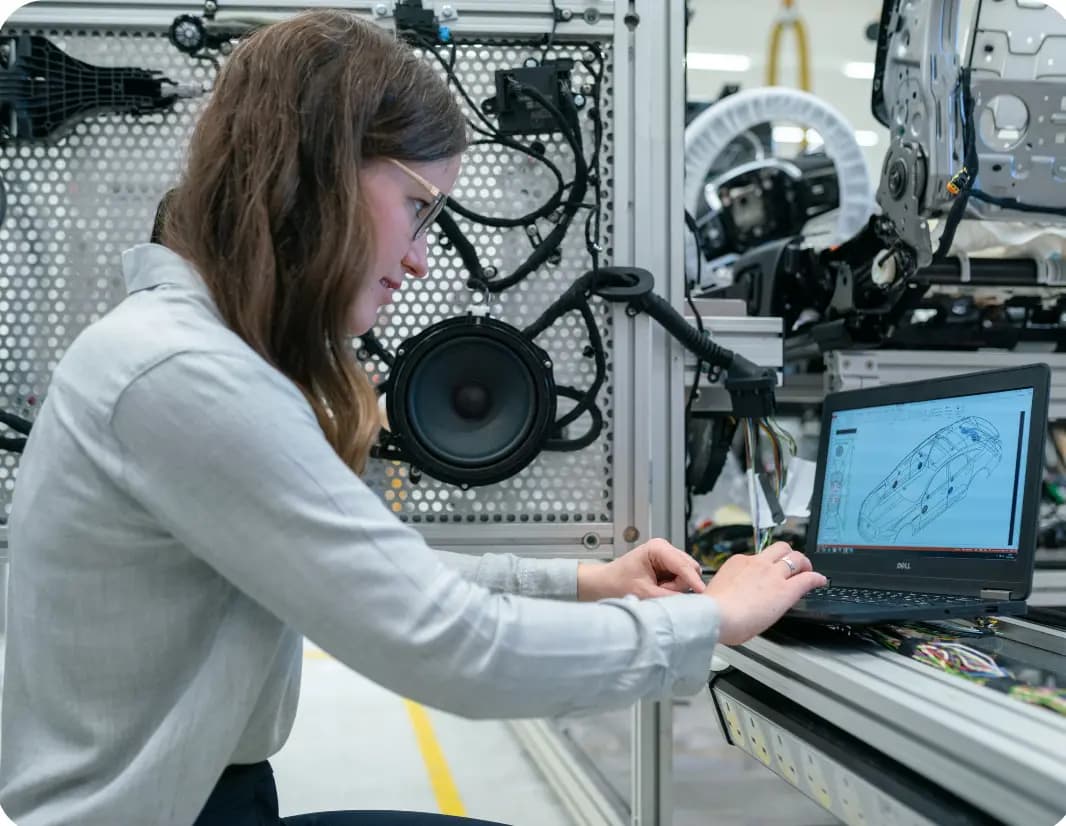
Predictive maintenance, vision inspection and forecasting that connect plant data to the business.
Data and AI for agriculture

Crop, sensor and imagery analytics designed for patchy connectivity and one growing season a year.
Retail operations and customer data

Demand forecasting, personalisation and unified customer data, tuned to the trading calendar.
FAQs
Questions about MLOps
Those platforms supply the parts: compute, training jobs, basic deployment. Pipelines, governance, drift monitoring and team workflow are still yours to assemble. That assembly happens on the platform you already license.
It depends on your starting level, the number of priority models and the governance you need. The assessment and roadmap come first, and they set out each phase's deliverables and entry criteria before implementation is scoped.
Rarely. The warehouse, cloud and notebooks you have stay; the gaps get filled. A component is swapped only if keeping it would cost more than leaving it.
Yes. Kubernetes-based platforms can run fully on-premise with an isolated registry, local artifact storage, internal DNS and no outbound network access. Nothing in the model lifecycle needs to reach the outside world.
When you run one or two models, retrain rarely, and nothing downstream breaks if a prediction is a day late. A scheduled job, version control and a release checklist may be enough. The assessment says so when it is.
Yes. LLMOps adds vector stores, prompt versioning, retrieval monitoring, token-cost tracking and guardrail evaluation. We build pipelines for fine-tuning open models, managing RAG systems and orchestrating agents, plus regression tests that run before any model version changes.
Two routes. Your team learns during the build through paired engineering, runbook walkthroughs and on-call shadowing. Or we operate the platform while your team concentrates on models, and hand it back when you're ready.
Each registered model carries a generated model card, lineage back to its data and code, and a log of the predictions it made, with bias and explainability tracking alongside. Tiered sign-off gates can be added where model-risk policy requires independent validation, and every artefact exports cleanly for whoever reviews it.

Pick one decision.
Measure before you build.
Tell us which decision a model should support and what a wrong answer costs. The first conversation covers your data and how the result will be judged. If an off-the-shelf model already passes, that is the answer you get.
Have a project in mind?
Bring the problem. The first call is about specifics, not slides.