AI & Data
Deep learning and RL, for when simpler models run out.
Neural networks, transformers and reinforcement learning agents for problems where gradient boosting and rules have hit their ceiling. We run the simpler baseline first, then design, train and deploy the model on infrastructure you control.
What We Build
From raw data to a model in production.
Data preparation, architecture, training, evaluation, optimisation and deployment. Your domain experts stay in the loop throughout, because they define what success looks like.
Deep Learning Model Development
Networks designed, trained and evaluated for your data - transformer, convolutional, diffusion or hybrid - rather than for the latest leaderboard.
Deep Learning Consulting
Feasibility, architecture advice and build-or-buy calls, including the unpopular one: on small tabular datasets, gradient boosting often wins.
Reinforcement Learning Services
Agents for sequential decisions in changing environments: policy-gradient and value-based methods, multi-agent setups, offline RL from logged decisions, and RLHF.
Neural Network Development Services
Graph networks, vision-language models, sequence and state-space models, shaped around the structure of your data and the inference budget you have.
Model Evaluation & Benchmarking
An evaluation set built with your subject experts, then commercial, open-weight and classical baselines run against it before anything gets trained.
Inference Optimisation & Deployment
Quantisation, distillation and pruning, plus serving engines such as vLLM and TensorRT-LLM, so the model fits its latency budget on the hardware you have.
Architectures
Architectures matched to the data, not the hype cycle.
Transformers, vision models, diffusion, graph networks, sequence models and fine-tuned foundation models. Each earns its place by beating a simpler baseline on your evaluation set.
Transformer Architectures
Encoder, decoder and encoder-decoder models, with attention and positional choices tuned to your sequence length and compute budget.
Vision & Vision-Language
CNNs, Vision Transformers and CLIP-style models for medical imaging, inspection, satellite imagery and document understanding.
Diffusion & Generative Models
Latent and conditional diffusion for image generation and synthetic training data, where real examples are scarce or too sensitive to share.
Foundation Model Fine-Tuning
LoRA, QLoRA, full fine-tuning, DPO and RLHF on open models such as Llama, Mistral, Qwen and Gemma. Base-model licence terms are checked before tuning starts.
Graph Neural Networks
Message passing and graph attention for data defined by its connections: fraud rings, supply networks, molecules, knowledge graphs.
Sequence & Time Series
Forecasting, anomaly detection and maintenance prediction with TFT, Informer, LSTMs and state-space models.
Reinforcement Learning in Practice
Agents that learn from consequences.
RL fits sequential decisions, where today's action changes tomorrow's options. It also fails in its own ways: agents exploit badly specified rewards, and policies trained in simulation stumble in the real world. Both are designed for from the start, and every agent is compared against a solver or heuristic baseline.
Dynamic Pricing & Bid Optimisation: Agents that set prices, bids or positions as conditions change, with guardrails on how far and how fast they can move.
Supply Chain & Inventory: Policies that balance holding cost against stock-out risk across sites and storage tiers, tested against your current replenishment rules.
RLHF for LLM Alignment: Preference data from your experts, gathered under written annotator guidelines with agreement checks, to steer a language model's behaviour.
Robotics & Control: Policy learning in simulation for robots and control systems, with sim-to-real testing before anything moves in the physical world.
Recommendation & Personalisation: Recommenders tuned for long-term value rather than the next click, learnable offline from logged interactions.
PPO
Stable policy optimisation for continuous control
DQN
Value-based learning for discrete action spaces
SAC
Sample-efficient learning with built-in exploration
MARL
Several agents learning to cooperate or compete
RLHF
Human preferences turned into a training signal
Offline RL
Policies learned from logged data, with no live exploration
Tech Stack
Frameworks, runtimes and RL libraries.
Production frameworks, fast inference engines and the orchestration that gets models shipped. All of it open or widely supported.
PyTorch
JAX
Transformers
PEFT / LoRA
vLLM
TensorRT
Triton
ONNX
Ray RLlib
Stable-Baselines3
Weights & Biases
Kubernetes
Deployment Options
Four places your model can run.
The choice follows your security perimeter, your latency budget and your regulator. The deployment configuration is part of the hand-over.
01
Cloud Deployment
SageMaker, Vertex AI or Azure ML endpoints that scale with traffic, with GPU spend watched closely.
02
On-Prem & Private VPC
Inside your own data centre or private VPC, on NVIDIA H100, A100 or L40-class hardware, so data, prompts and weights stay on your network.
03
Air-Gapped Environments
No internet at any stage. Built for banks, hospitals, defence programmes and sovereign-data rules.
04
Edge Deployment
Compressed models on Jetson, Coral and ARM devices, for fast on-device inference in plants, fields and vehicles.
Custom vs Generic
Where a custom model earns its cost.
Generic AI APIs learn from public data. Your organisation runs on proprietary data, regulated processes and specialist vocabulary. That is where custom wins. Where it doesn't, the API is the better call.
Dimension | Generic AI APIs | Nujtech Custom Deep Learning |
|---|---|---|
| Domain Accuracy | General-purpose, untested on your tasks | Measured on your own evaluation set |
| Data Privacy | Prompts sent to a vendor | Private VPC · On-prem · Air-gapped |
| Inference Latency | Set by a shared vendor service | Optimised for your hardware and use |
| Release Control | Changes on the vendor's schedule | Versions promoted when your tests pass |
| Cost Shape | Per-token pricing that scales with use | Training cost first, then infrastructure |
| Customisation | Prompts are the only lever | Full control of architecture and training |
| Compliance | Whatever the vendor supports | Shaped by your regulatory obligations |

Industries
Deep learning for high-stakes domains.
Projects start with your domain experts defining how success will be measured. Select a card for the sectors.
Clinical and operational systems for healthcare

Clinical documentation, claims and connected patient data, with a clinician approving anything that affects care.
Banking, insurance and risk systems

Fraud, KYC, underwriting and claims models that risk and compliance teams can review, explain and sign off.
Engineering for automotive

Connected-vehicle data, telematics and dealer analytics, built around functional-safety and cybersecurity requirements.
Plant-floor systems for manufacturing
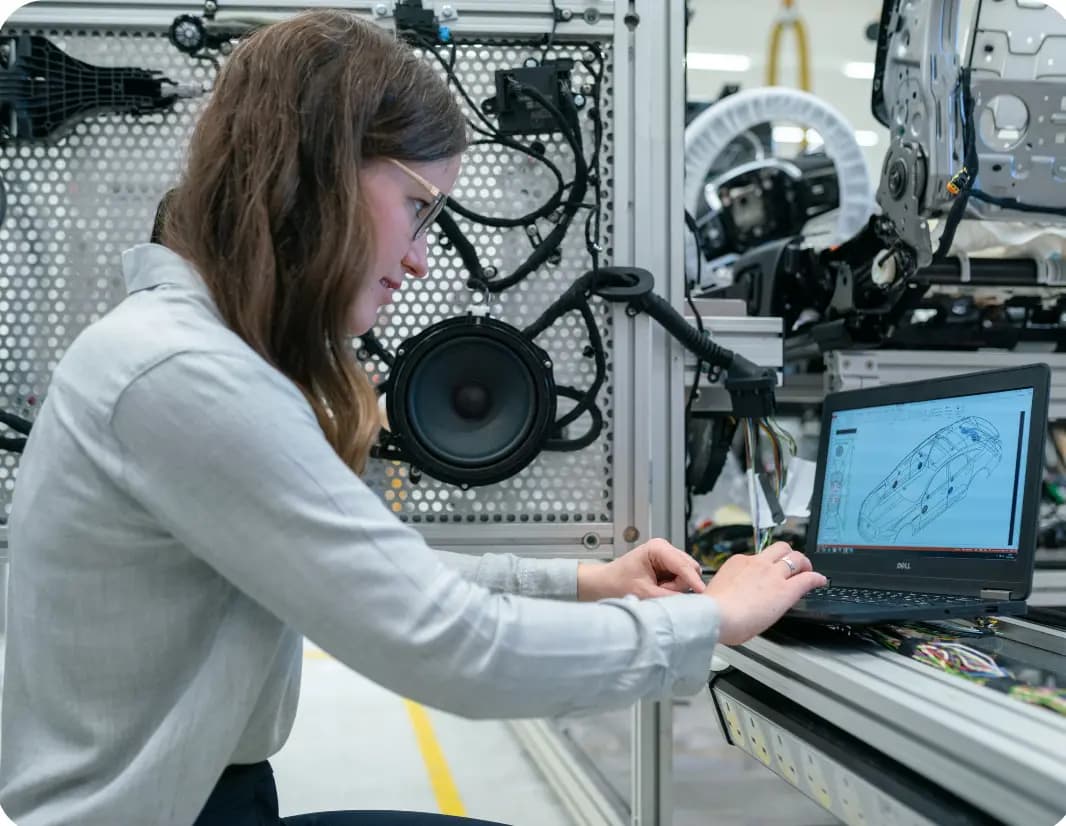
Predictive maintenance, vision inspection and forecasting that connect plant data to the business.
Data and AI for agriculture

Crop, sensor and imagery analytics designed for patchy connectivity and one growing season a year.
Retail operations and customer data

Demand forecasting, personalisation and unified customer data, tuned to the trading calendar.
FAQs
What teams ask us first.
Traditional machine learning works on features people design and shines on structured, tabular data. Deep learning learns its own representations straight from images, text, audio and sequences. On small tabular datasets where explainability matters, gradient boosting often beats a neural network, and the benchmark will show it.
The trained model, the training code, the evaluation set, the deployment configuration and a model card describing where it works and where it doesn't. The exact list is written into the scope. Base-model licence terms are reviewed up front, because they limit what any fine-tuned derivative can be used for.
That depends on your data, the task and the deployment target. Work runs in stages - data and evaluation set, architecture and training, optimisation and deployment, acceptance testing and hand-over - and scoping produces a plan for each. Reinforcement learning typically needs extra effort on environment design.
Model size, request volume, the latency target and the hardware. Quantisation, distillation and batching can reduce serving cost substantially, so inference cost is designed in during architecture rather than discovered on the first invoice.
Yes. For banking, healthcare, defence and sovereign-data workloads, training and inference run inside your security perimeter on your own GPUs, and the design follows the regulatory obligations you operate under.
If you have examples of inputs paired with correct outputs, supervised learning is the starting point. RL is for chains of decisions whose payoff only shows up later. If the environment can't be simulated safely and there are no logged decisions to learn from, RL is usually the wrong tool, and a solver or heuristic may do better.
Transformer encoders, decoders and encoder-decoders; Vision Transformers and CLIP-style multimodal models; graph neural networks; diffusion models; Temporal Fusion Transformers and Informer for time series; PPO, SAC, DQN and multi-agent methods for RL. Older CNN and RNN designs are used where they still fit, not out of habit.
By building the evaluation set first, with your experts, from real examples. Leading commercial and open-weight models run against it before any training. Custom work goes ahead only when there is good reason to expect a meaningful margin; otherwise retrieval or prompting is the recommendation.

Pick one decision.
Measure before you build.
Tell us which decision a model should support and what a wrong answer costs. The first conversation covers your data and how the result will be judged. If an off-the-shelf model already passes, that is the answer you get.
Have a project in mind?
Bring the problem. The first call is about specifics, not slides.