AI & Data
Computer vision tested where your cameras actually are
Detection, segmentation, OCR, inspection and video analytics, trained on your images and tested under your lighting, angles and line speeds. A model that scores well in the lab and misses defects on the floor isn't finished.
What We Build
Six computer vision services
Six services. Each starts by asking whether vision is the right tool, and ends with a model tested where it will run.
Computer Vision Consulting & Strategy
First question: is vision the right tool? Sometimes a barcode, an RFID tag or a simple sensor is cheaper and more reliable. We check that, then define the use case, the camera setup, the data plan and a phased roadmap.
Object Detection & Recognition
Detectors that spot and box what matters in stills and live feeds: a defect on a line, a vehicle at a gate, a gap on a shelf, a device on a ward. Trained on your own footage, not a public dataset.
Image Segmentation & Classification
Pixel-level regions and labels where a bounding box is too coarse: scan analysis, crop and land imagery, material grading, product attributes.
Face Recognition & Biometric Systems
Verification for access, identity checks and attendance, with liveness detection, bias testing across demographic groups, and a consent and legal review before anything is deployed.
OCR, ICR & Intelligent Document Processing
Printed and handwritten text from invoices, prescriptions, forms and IDs, extracted into structured fields and passed to the systems that need them. Nobody retypes it.
Real-Time Video Analytics & Surveillance Intelligence
Safety-gear checks, crowd counts, heat anomalies and footfall from cameras you already own, running on edge hardware when the decision can't wait for a round trip to the cloud.
HOW IT RUNS
Our computer vision delivery process
Six phases, each named for the artefact it produces. Feasibility comes first, so a poor fit stops before the build starts.
Feasibility and the camera question
We look at the problem, the footage, the infrastructure and any legal constraints, then say plainly whether vision fits each use case or whether something simpler would. Costly mismatches get caught here, not in production.
DELIVERABLES
- Use cases ranked by value and risk
- Vision versus non-vision recommendation
- Camera and hardware requirements
- Data readiness review
- Cost of a miss versus a false alarm
- Architecture outline
How It Works
How an enterprise vision system gets built
The decisions at each stage set how well the model holds up outside the lab. Each card below is one of those stages.
Cameras, Conditions & Data
A vision model is bounded by what the camera sees. We review resolution, frame rate, lens and mounting first, then the footage you already hold. Labelling covers boxes, masks, key points or polygons, and the data is checked for the rare cases that matter most: the defect that turns up seldom but costs the most.
Model Architecture & Training
Model families differ by task - single-stage or two-stage detectors, encoder-decoder segmenters, convolutional or transformer classifiers. The choice trades speed against precision for your line rate, and training uses your images rather than a public benchmark.
Integration & Deployment
The model connects to ERP, MES, SCADA or a custom platform through secure APIs. It runs in the cloud, on your own GPU servers, including isolated networks, or on edge devices such as NVIDIA Jetson or Intel OpenVINO hardware where the network can't be trusted.
Monitoring & Retraining
Light changes with the seasons, products get redesigned, lenses get dirty. Monitoring watches confidence and input drift, low-confidence frames go to people, and retraining runs when the evidence shows performance slipping.
Tuned on Your Cameras vs a Generic Vision API
Where the gap shows up on a real line
Broad
Built for everyday objects, not your parts or defects
- Images processed on third-party servers
- No notion of your defect categories
- Unstable when light or angle changes
- Can't be retrained on your footage
Tuned
Trained and tested on your own cameras
- Can run on-site or on edge hardware
- Trained on your exact parts and defects
- Tested on a site the model never saw
- Retrained as conditions change
Technical Depth
Six capabilities, one test standard
Classical image processing and modern deep learning are tools, not rivals. Many production pipelines use both.
Here is what each capability is for.
Each model is judged on held-out footage from your own cameras, not on public benchmark scores that never saw your conditions.
Image & Video Analysis
Streams turned into counts, tracks, dwell times and event alerts, with enough temporal context that a person walking past isn't flagged as loitering.
Object Detection & Recognition
Detectors from the YOLO, Faster R-CNN, SSD and DETR families, sized to the speed your line or feed demands and the precision a miss costs.
Face Recognition & Biometrics
ArcFace- and FaceNet-style embeddings with liveness and anti-spoofing checks, bias testing across demographic groups, and a legal review of consent before rollout.
OCR & ICR Document Intelligence
Printed and handwritten text read from complex layouts - prescriptions, contracts, invoices, forms - paired with layout models that know which field is which.
Spatial Analysis & 3D Vision
Depth estimation, point clouds and 3D reconstruction from ordinary cameras, for robot guidance, navigation, warehouse mapping and measurement.
AI Image Processing & Enhancement
Denoising, deblurring and super-resolution ahead of analysis, for medical scans, satellite tiles and ageing archives.
Our CV Stack
Frameworks, tools and edge runtimes
Detection frameworks, labelling tools and edge runtimes. The task, the hardware beside the camera and the line speed decide what goes into the build.
Model Architectures
Deep Learning & Training
Data & Annotation
CV & ML Frameworks
Edge & Deployment
Cloud & Infrastructure
Model-agnostic. The architecture follows the task and the hardware, not our habits.
WHERE IT BREAKS
Three ways vision systems fail on the floor.
Each one passes a demo. Each one surfaces in production unless the test set was built to catch it.
The Defect Nobody Labelled
Inspection lives or dies on rare classes. If the training set holds few examples of the failure you care about, the model learns to ignore it.
Lab Light, Factory Floor
A model trained on clean, well-lit samples falls apart under glare, dust, motion blur or a new camera angle. Field conditions belong in the test set.
The Wrong Error Treated as Cheap
A missed defect and a false alarm cost very different amounts. If nobody prices them, the model gets tuned to avoid the wrong one.
WHY US
Four rules we build vision systems by
01
Vision Only Where It Fits
If a barcode, an RFID tag or a sensor solves the problem more cheaply, that is the recommendation. Vision has to beat the simpler option, not just work.
02
Tested on a Site It Never Saw
Held-out data comes from a different line, store, shift or season. A model that only works where it was trained isn't ready to ship.
03
Edge-Ready by Design
Models are sized for the hardware beside the camera when the network is slow, unreliable or off-limits. The cloud is an option, not an assumption.
04
People in the Loop
Low-confidence frames go to a reviewer, and every correction feeds the next training run. The system shows its doubt instead of hiding it.
INDUSTRY APPLICATIONS
Computer vision wherever an image is the evidence
Select a card to see where vision fits each sector.
Clinical and operational systems for healthcare

Clinical documentation, claims and connected patient data, with a clinician approving anything that affects care.
Banking, insurance and risk systems

Fraud, KYC, underwriting and claims models that risk and compliance teams can review, explain and sign off.
Engineering for automotive
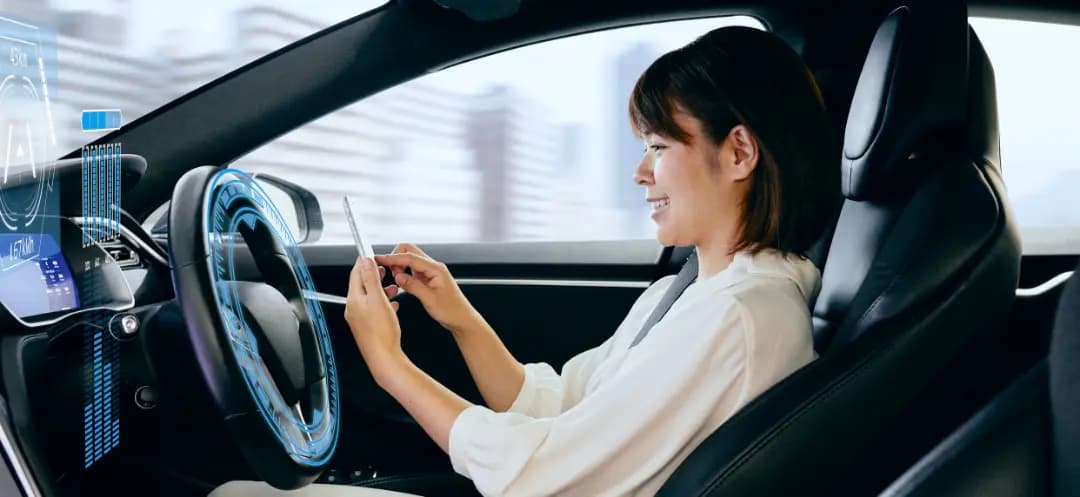
Connected-vehicle data, telematics and dealer analytics, built around functional-safety and cybersecurity requirements.
Plant-floor systems for manufacturing
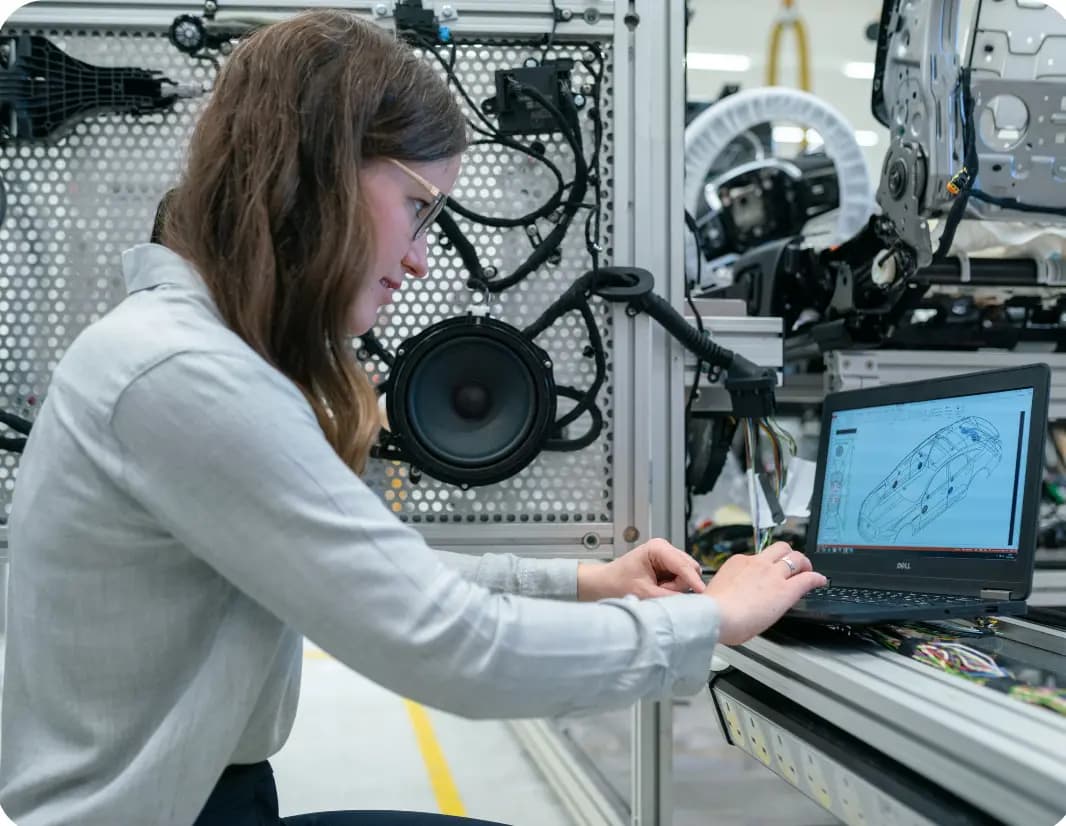
Predictive maintenance, vision inspection and forecasting that connect plant data to the business.
Data and AI for agriculture

Crop, sensor and imagery analytics designed for patchy connectivity and one growing season a year.
Retail operations and customer data

Demand forecasting, personalisation and unified customer data, tuned to the trading calendar.
FAQs
Questions about computer vision services
The work of designing, building and running systems that understand images and video: spotting defects, reading documents, counting people, verifying identity, checking safety compliance. A full engagement covers camera setup, labelling, training, integration, field validation and monitoring.
As accurate as the data, the task and the conditions allow, which is why no honest provider quotes a number up front. We agree the metric that matters - often recall on the costliest class - and test it on held-out data from a site the model hasn't seen.
It depends on how much labelled footage exists, how many classes are involved and how deep the integration goes. The feasibility phase ends with a go or no-go and a phased plan stating what each phase delivers.
Resolution, frame rate, lens, lighting and mounting decide what a model can see. The feasibility phase produces a hardware specification, and existing cameras are reused wherever they are good enough for the task.
Yes. Models can run on NVIDIA Jetson or OpenVINO-class devices beside the camera, or on your own GPU servers, when you need fast responses, no cloud dependency, or footage that never leaves the site.
Images or footage of the real task, including the failures you want caught, and someone who can say what each label means. Rare classes matter most and are usually the bottleneck. If there isn't enough, the feasibility report explains how to gather more.
Traditional image processing applies fixed rules: edges, thresholds, templates. Computer vision learns patterns from labelled examples and generalises to images it hasn't seen. Rules still win in simple, tightly controlled scenes, and often sit inside the final pipeline.
That depends on the jurisdiction, the purpose and the consent you can obtain, and the rules differ sharply between regions. We treat it as a feasibility question, worked through with your legal team before any biometric system is designed.

Pick one decision.
Measure before you build.
Tell us which decision a model should support and what a wrong answer costs. The first conversation covers your data and how the result will be judged. If an off-the-shelf model already passes, that is the answer you get.
Have a project in mind?
Bring the problem. The first call is about specifics, not slides.